
Understanding Standard Door Hinge Sizes for Every Home
Understanding Standard Door Hinge Sizes for Every Home
The most common standard door hinge size for residential doors is 4 inches. Homeowners install three hinges per standard door, supporting study, bedroom, and bathroom doors. Selecting the correct hinge size prevents sagging and ensures reliable performance. TDC leads the industry with 35 years of experience and global reach.
Metric | Value |
|---|---|
Years of Experience | 35 years |
Doors Stabilized Globally | 400 million+ |
Standard Door Hinge Size Guide
Common Sizes for Interior and Exterior Doors
Selecting the right standard door hinge size ensures smooth operation and long-lasting performance for every door in a home. Many homeowners often ask, "Are door hinges a standard size?" or "What is a standard door hinge size?" The answer depends on the type of door and its application.
For residential interiors, the most common measurements for door hinges are:
3.5 inches by 3.5 inches for bedroom, bathroom, and closet doors.
4 inches by 4 inches for exterior entry doors, which require more support due to increased weight and thickness.
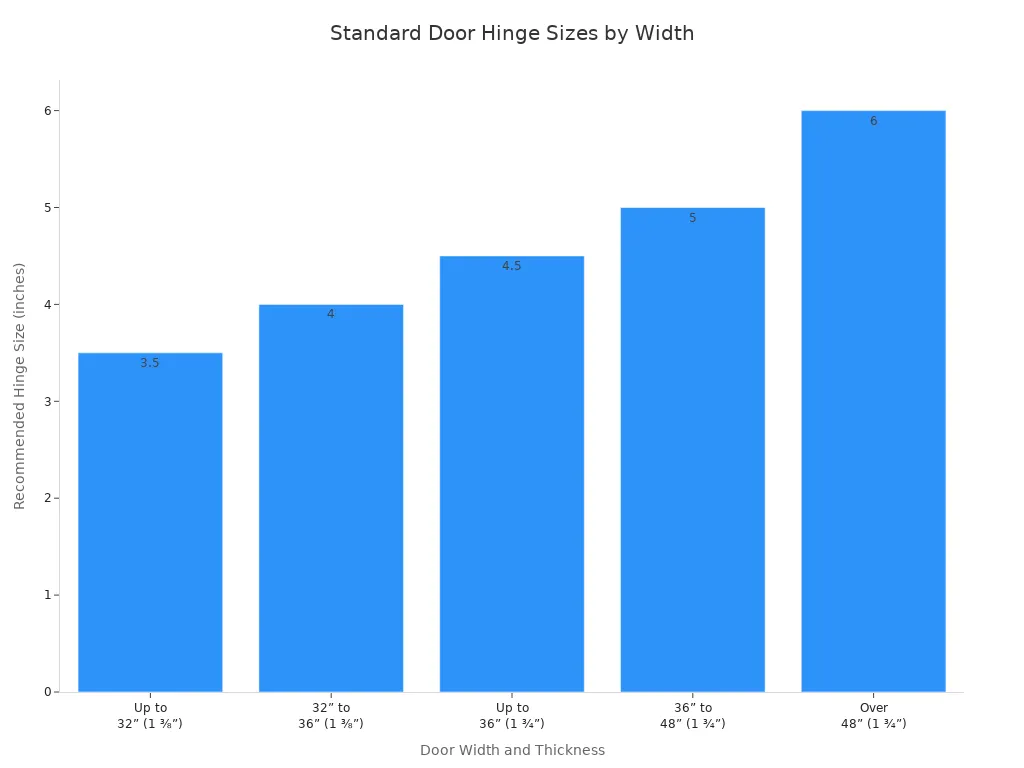
These sizes cover the majority of standard interior and exterior doors found in homes. However, larger or heavier doors may require hinges with greater length or width. The following table summarizes the recommended hinge sizes based on door thickness and width:
Door Thickness | Door Width | Recommended Hinge Size |
|---|---|---|
1 ⅜” | Up to 32” | 3 ½” |
1 ⅜” | 32” to 36” | 4” |
1 ¾” | Up to 36” | 4 ½” |
1 ¾” | 36” to 48” | 5” |
1 ¾” | Over 48” | 6” |
TDC offers a wide range of door hinges to fit these standard sizes, as well as custom solutions for unique projects. Their advanced manufacturing capabilities allow for precise control over hinge length and finish, ensuring compatibility with any door specification.

Why Hinge Size Matters
Choosing the correct standard door hinge size is critical for both safety and durability. When the hinge matches the door's thickness and weight, it prevents unnecessary stress on the frame and hardware. Using the wrong size can cause several issues:
Hinges that are too small may weaken the door and frame structure.
Misaligned or undersized hinges can lead to twisting or binding, resulting in uneven stress and premature wear.
Properly sized door hinges distribute the weight evenly, allowing the door to open and close smoothly. This attention to detail extends the life of both the door and the hinge itself.
TDC understands that not every project fits the mold. For doors with non-standard dimensions or special requirements, TDC provides factory-direct customization. The table below highlights the available customization options:
Customization Aspect | Description |
|---|---|
Dimensions | Tailored to match unusual door sizes and non-standard frames. |
Materials | Options for various materials to suit specific project needs. |
Finishes | Fully customizable finishes to align with décor or client preferences. |
Special Functionalities | Designed for specific performance needs, such as heavy-duty or concealed doors. |
Tip: Always measure both the height and width of your existing hinges before ordering replacements. This ensures a perfect fit and optimal performance.
Types of Door Hinges for Homes
Residential vs. Commercial Hinges
Residential and commercial doors require different hinge types based on size and load capacity. Residential hinges usually measure between 3.5 and 4 inches, supporting lighter interior doors. Commercial hinges often reach 4.5 inches or more, designed to handle heavier, high-traffic doors. Commercial hinges feature reinforced construction and ball bearings for smoother operation and increased durability. TDC manufactures both residential and commercial hinges, offering options that fit standard and custom specifications.
Note: Commercial hinges provide greater load capacity and longevity, making them suitable for schools, hospitals, and office buildings.

Specialty and Heavy-Duty Hinges
Specialty and heavy-duty hinge types address unique needs in homes and businesses. These hinges offer advanced features such as increased strength, concealed installation, or automatic closing. The table below highlights several specialty hinge types, their structural features, advantages, and typical applications:
Hinge Type | Structural Features | Advantages | Typical Applications |
|---|---|---|---|
Butt Hinges | Central pin, ball bearings | Smooth motion, easy installation | Heavy doors, industrial doors |
Piano Hinges | Full-length design | Uniform load, prevents sag | Cabinets, security enclosures |
Offset Hinges | Pivot axis offset | Maximizes clearance | ADA-compliant doors, equipment rooms |
Concealed Hinges | Hidden when closed | Tamper resistance, sleek look | Security doors, modern cabinetry |
Strap Hinges | Long leaves | High load-bearing, rustic style | Barn doors, gates |
Pivot Hinges | Floor-mounted pivots | Extreme load capacity | Monumental doors, glass panels |
Weld-On Hinges | Welded to metal frame | Ultra-strong, permanent mount | Machinery guards, containers |
TDC’s product range includes ball bearing hinges for smooth operation, spring hinges for automatic closing, and stainless steel hinges for rust resistance. Homeowners in coastal or humid regions benefit from stainless steel or coated hinges, which prevent corrosion and ensure long-term reliability.
Regular maintenance extends hinge life. Clean hinges, lubricate pins, tighten screws, and replace damaged units as needed. Heavy-duty hinges cost more upfront but deliver superior durability and performance, making them a smart investment for demanding environments.
Hinge Measurements and Selection
How to Measure Door Hinges
Accurate hinge measurements ensure a perfect fit and smooth door operation. Follow these steps for precise results:
Lay the hinge flat and measure the height from the top edge to the bottom. Common lengths include 3", 3.5", 4", and 4.5".
Open the hinge fully. Measure the width from the outside edge of one leaf to the outside edge of the other.
Use a caliper or ruler to check the thickness of each leaf.
Measure the distance between screw holes, both vertically and horizontally, to match the existing pattern.
Examine the knuckle and pin for compatibility, especially for heavy or wide doors.
Recommended tools for sizing hinges include a tape measure, pencil, level, and notepad. These tools help ensure accurate hinge length and placement.
Key Hinge Measurements Explained
Understanding hinge terminology helps with selecting the right product. The table below explains essential terms:
Term | Definition |
|---|---|
Gauge | The measurement of a hinge's thickness, also called leaf thickness. |
Knuckle | The circular, rolled part of the hinge that encases the pin, sometimes called the barrel. |
Pitch | The distance from the side of one knuckle to the same edge of the next knuckle. |
Quick Reference Chart
Use this chart to match standard door types with recommended hinge sizes and TDC options:
Door Type | Hinge Size | Door Thickness | Use Frequency |
|---|---|---|---|
Residential Interior Door | 3.5" x 3.5" | 1-3/8" | Low |
Residential Entry Door | 4" x 4" | 1-3/4" | High |
Heavy Exterior Door | 4.5" x 4.5" | 1-3/4" | High |
Tip: Always measure both the height and width of your existing hinge before ordering replacements. For heavy or wide doors, select a longer hinge length for added support.
Practical tips for sizing hinges include assessing the door’s weight and material, learning basic hinge types, and consulting experts if unsure. Proper installation involves aligning hinges with a level, marking screw holes accurately, pre-drilling, and applying lubricant for smooth operation. Regular maintenance extends hinge life and ensures reliable performance.
Selecting the correct standard door hinge size ensures safety and long-term durability.
Hinges support door weight and maintain smooth operation.
Stainless steel hinges resist rust in humid areas.
Using the measuring guide and reference chart helps match hinge size to door weight, material, and use.
TDC delivers quality, customization, and reliable customer support.
FAQ
Are door hinges a standard size?
Most residential door hinges follow standard sizes, such as 3.5" x 3.5" for interior doors and 4" x 4" for exterior doors. Custom sizes remain available.
Are door hinges standard size?
Many door hinges use standard measurements, but some doors require custom hinge sizes. Always measure the existing hinge before purchasing replacements.
What is a standard door hinge size?
The most common standard door hinge size for interior doors is 3.5" x 3.5". Exterior doors typically use 4" x 4" hinges.
Related articles
-

The Importance of Choosing the Right Commercial Hinges for Your Business
Choosing the right commercial hinges boosts safety, reduces maintenance costs, and ensures reliable door performance for any business environment.Feb-05-2026 Learn More >> -

Why Brass Hinges Are the Perfect Choice for Modern Homes
A brass hinge resists tarnish, adds timeless style, and suits any décor, making it the ideal choice for modern homes seeking durability and elegance.Feb-05-2026 Learn More >> -

Easy Tips for Installing Door Hinges at Home
Follow these easy steps on how to install door hinges at home for a secure fit, smooth operation, and lasting results using basic tools.Feb-05-2026 Learn More >> -
How to Choose the Perfect Inside Door Hinges for Every Room
Choose the right inside door hinges by considering door weight, room use, hinge type, and finish for smooth function and a style that fits your home.Feb-05-2026 Learn More >>

Contact
Tel: +8615026919634
Email: allen@tdc-hardware.com
Add: 12819 Telegraph Road Santa Fe Springs, CA 90670
Follow Us:


